Rovey
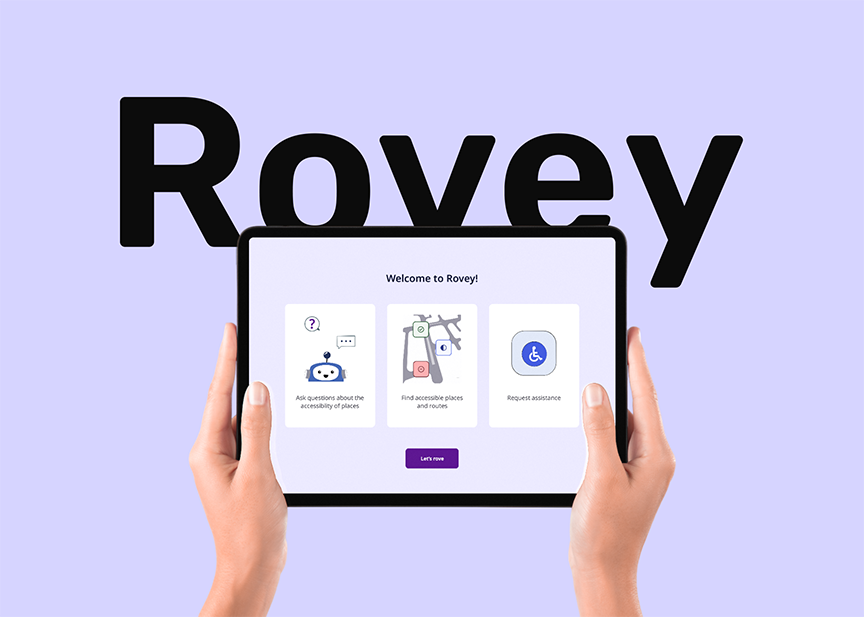
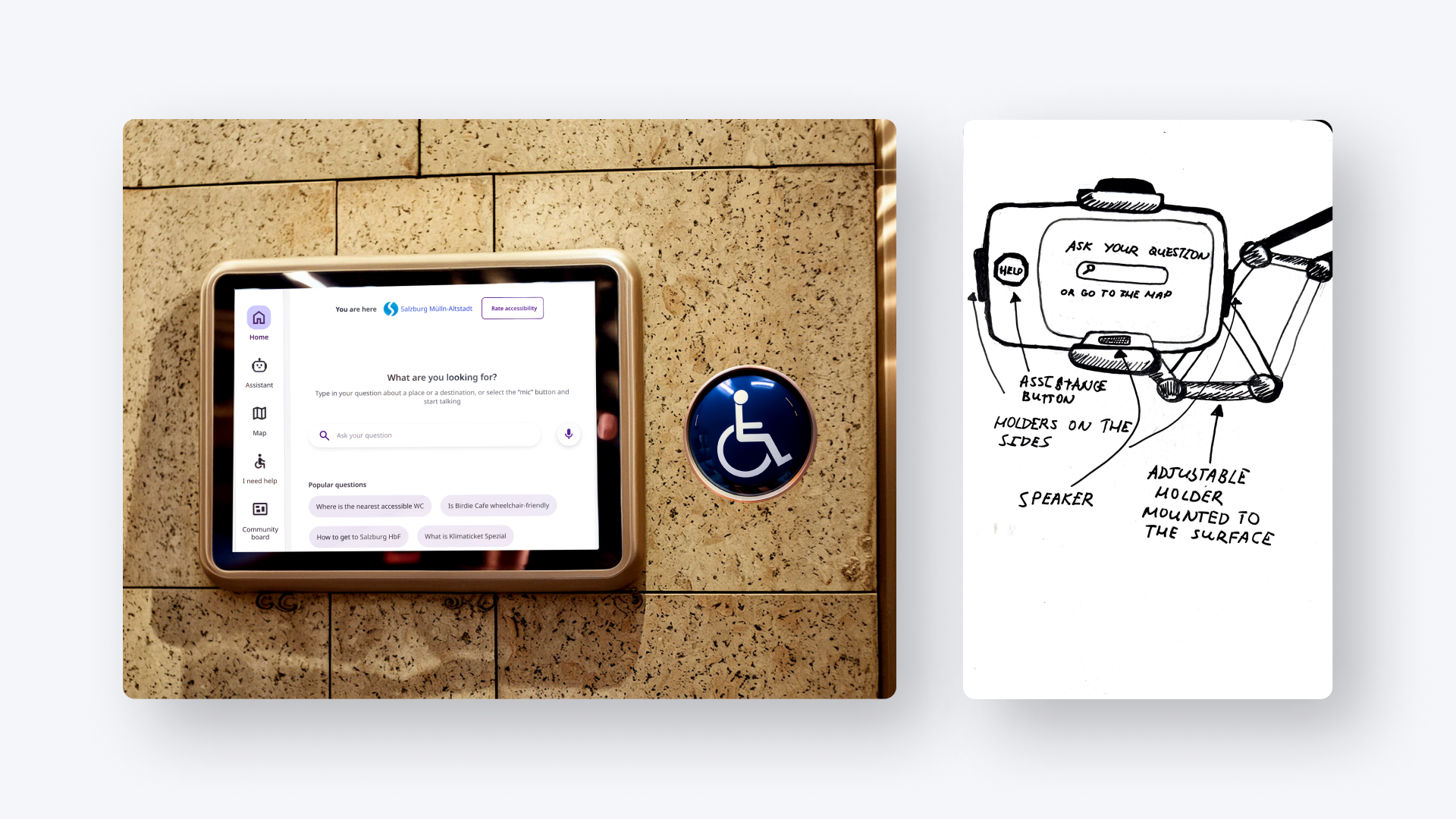
Rovey is an AI-powered device designed to help wheelchair users navigate their surroundings confidently and promote a more inclusive city by mapping urban accessibility. Shaped like a tablet, Rovey attaches to various surfaces and offers features like an AI-assistant, a collaborative accessibility map, an assistance button, and a public messaging board.
Project Info
Role
UX/UI Designer, Researcher, Concept
Tools
Figma, Adobe Illustrator
Device
Tablet
#1 Overview
Problem (s)
- A gap between able-bodied designers and users with disabilities often results in solutions that lack value.
- Navigating an (un)familiar urban environment in a wheelchair is challenging and overwhelming
- Existing mobile solutions often overlook wheelchair users by not considering other potential motor impairments.
- Wheelchair users often find it hard to ask for help because it makes them feel vulnerable.
OUTCOME
- I designed a card-based toolkit and held a co-creation session with wheelchair users.
- I developed a concept of a public tablet-like device to find and rate accessible places in the city.
- I added a voice interaction functionality to reduce reliance on typing as well as increased the size of touch targets and spacing between them.
- I added a button that lets users call a service worker and get updates on that call.
#2 Design Process

1. Research
Conducted desk research and interviews with experts in the field of inclusive design and human rights

2. Toolkit Design
Designed the toolkit which included a deck of ideation cards, a worksheet, an instruction, and physical DIY materials

3. Co-creation Session
Conducted a 2-hour- session with 5 wheelchair users aged 54-59 who made 4 design artefacts

4. Analysis
Analysed the expert interviews with affinity diagramming and the co-creation session with qualitative content analysis

5. User Stories
Formulated 5 user stories for the first iteration based on the research insights

6. Design Guidelines
Formulated 8 key guidelines based on the research findings and the WCAG standards

7. Prototype
Created LoFi & MidFi wireframes
*this project did not cover the usability testing session
#3 Meet Amelia
Amelia is a 54-year-old Senior HR advisor based in Salzburg, Austria. Diagnosed with multiple sclerosis 15 years ago, she soon had to start using mobility aids and now uses a power wheelchair. Her fine motor skills are also decreasing, which makes it difficult to write and type sometimes. Amelia leads an active social life and enjoys helping others. However, she dislikes having to fight for every change in her environment, be it requesting a better ramp or arguing that the hallways are too narrow.

Environment
- lives in the mid-size city
- works remotely most of the time, attends the meetings in the office sometmes
- commutes by trains and buses

Goals
- remain independent when moving around
- visit new places
- support other people with disabilities
- make the city more inclusive without mental exhaustion

Abilities & Limitations
- likes to do things herself
- relies on a power wheelchair to get around
- has reduced upper and lower body mobility

Challenges
- narrow door frames and hallways
- lack of information on accessibility of places and paths
- feeling occasionally alienated and tired of the pressure to advocate for disability rights

#4 MidFi wireframes
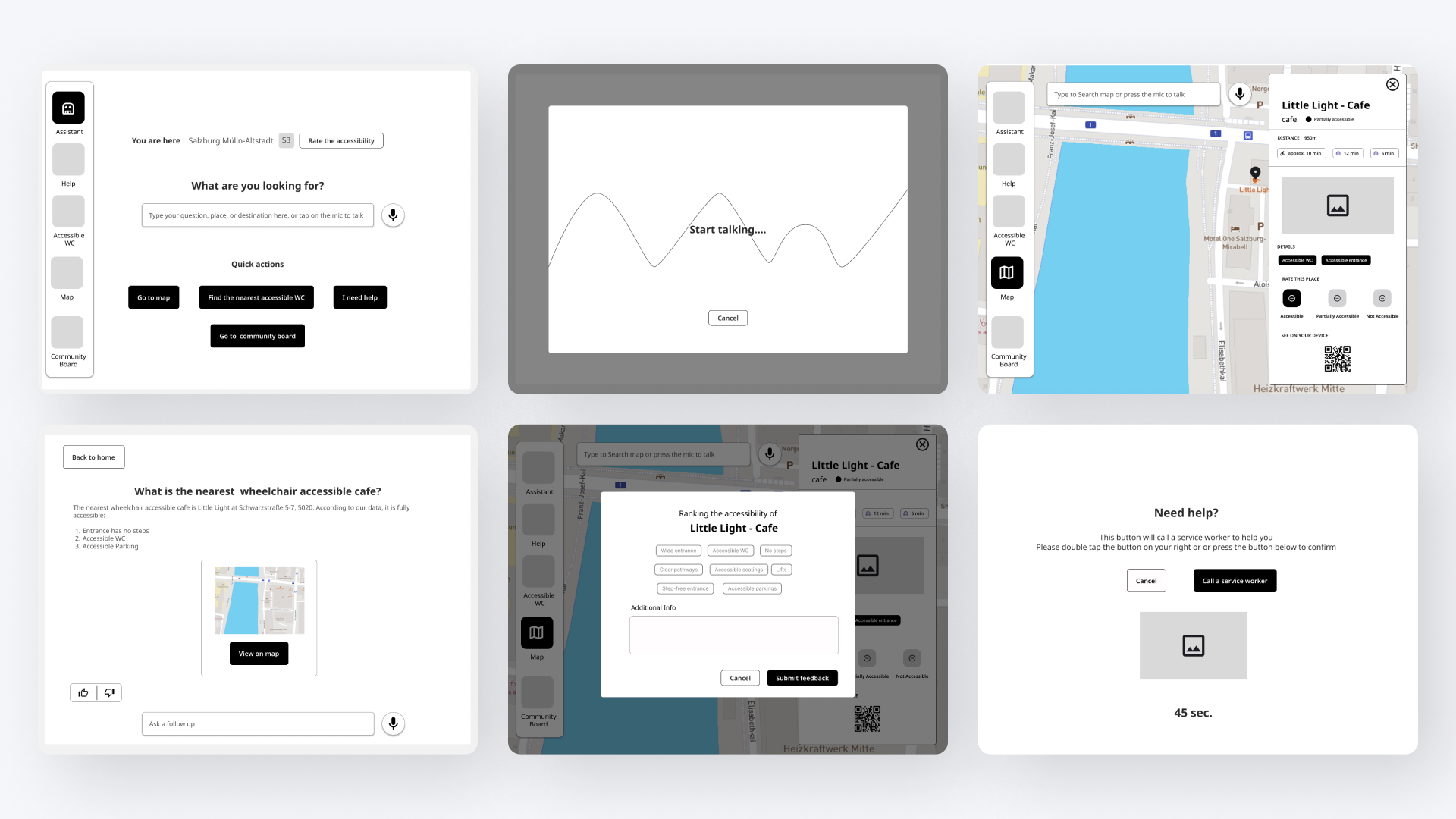
Functionality 1: AI Assistant
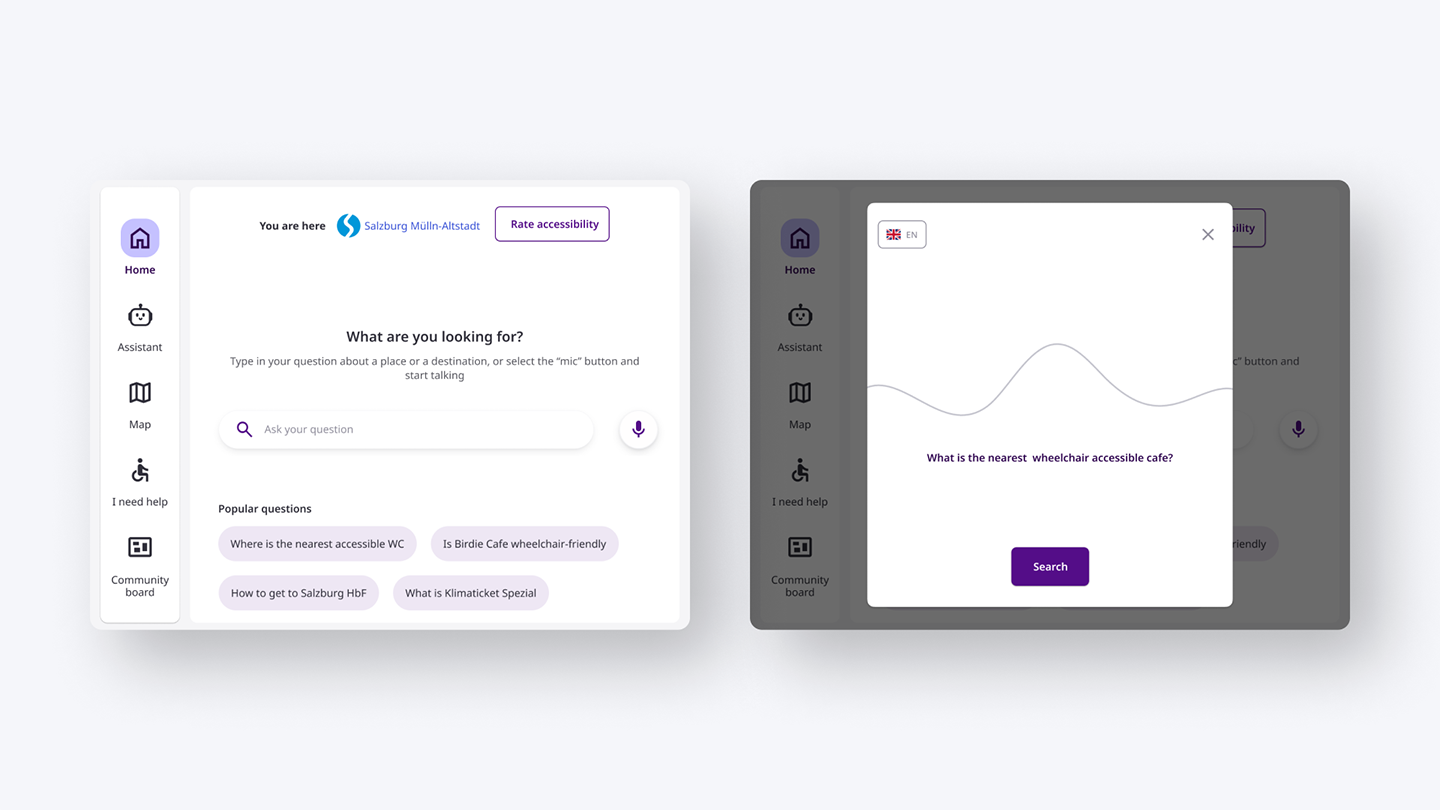
As a user, Amelia wants to have access to an AI-powered assistant, so that she can receive real-time navigation help and personalized advice on navigating her surroundings and finding accessible places.
Key design decisions
- Increased interactable elements and touch targets to a minimum of 64px, exceeding the Material Design (48px) and Human Interface Guidelines (44px).
- An ever-present side menu provides easy task switching and visually separates the menu from the main information and actions area.
- Search functionality together with prompts on the start screen to encourage using the assistant.
- Added voice interaction to reduce reliance on typing.
Functionality 2: rANKING ACCESSIBILITY
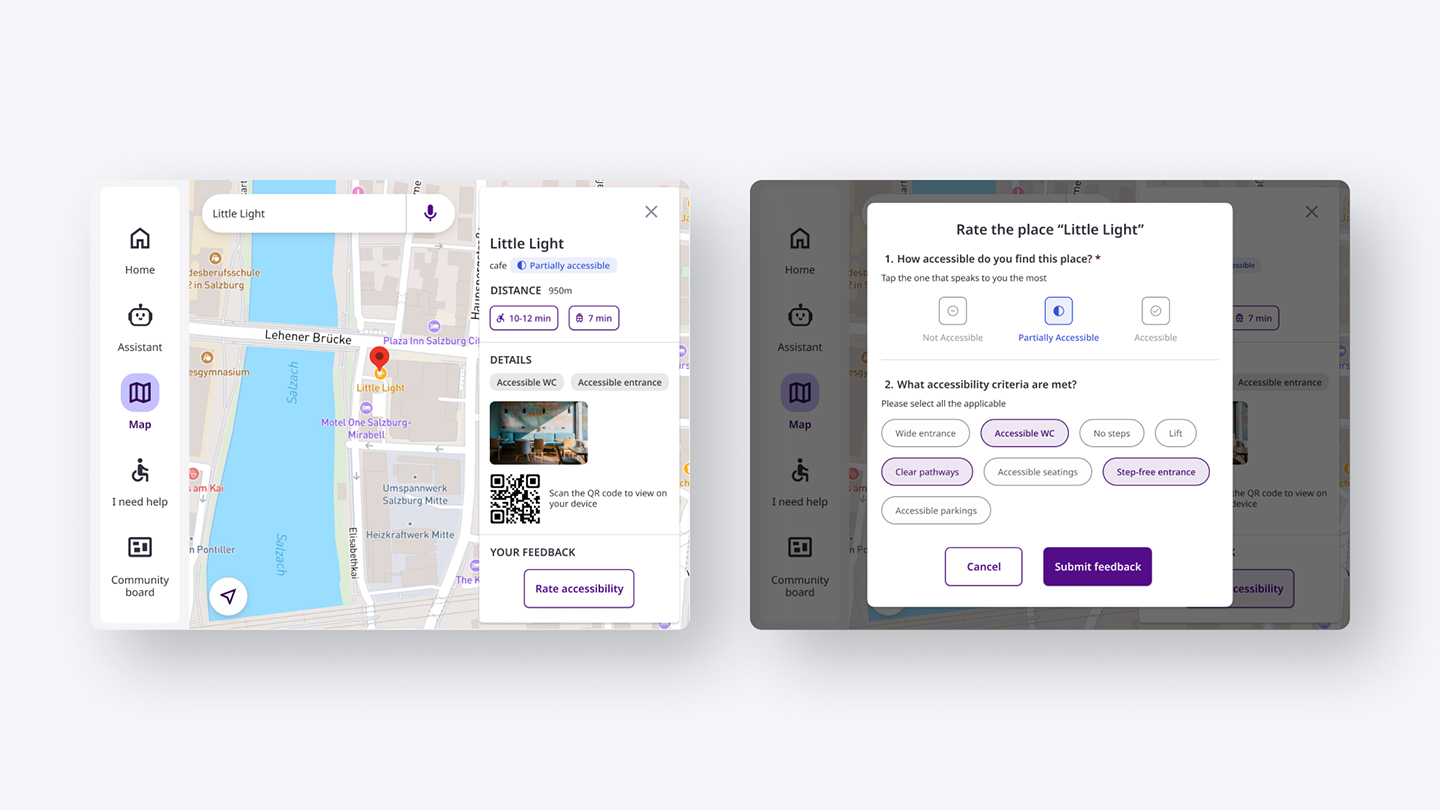
As a user, Amelia wants to rank the accessibility of public places based on relevant criteria, so that other wheelchair users can know how accessible the place is.
Key design decisions
- Provide users with three options to choose from based on their subjective feelings about the place and offer more precise criteria to justify their choice
- Increase the spacing between elements (24px) to prevent accidental touches.
- Limit the assessment of the place to two steps, so the user does not feel overwhelmed.
Functionality 3: ASSISTANCE BUTTON
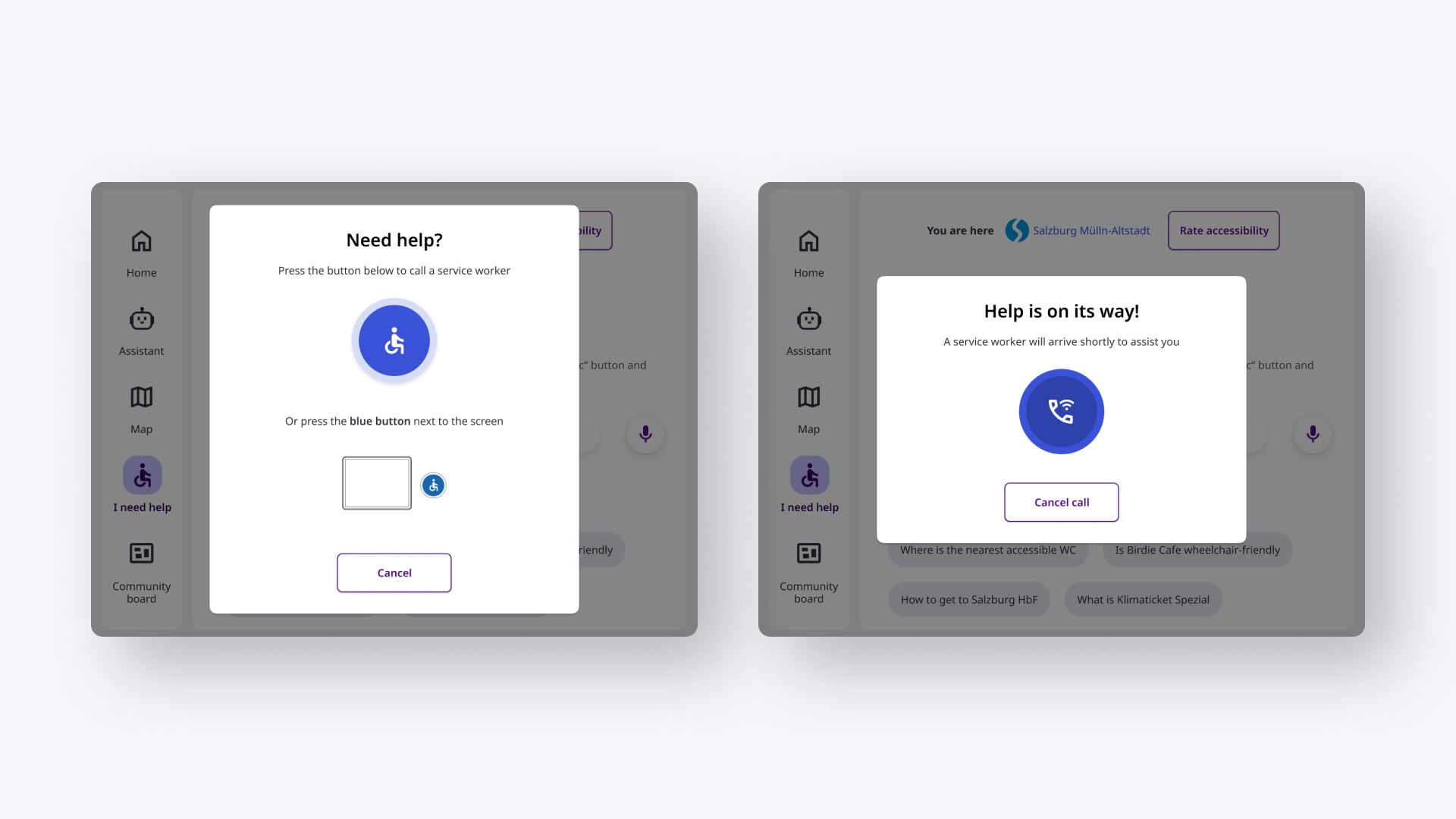
As a user, Amelia wants to have access to both a physical and a digital button to request assistance, so that she can she can easily get help when she needs it without having to search for a service worker and be aware of the status of her call.
Key design decisions
- Make the digital button round to resemble the physical button.
- Add an option to cancel the request if the button is pressed accidentally.
- Change the appearance of both the button and the pop-up after the button is pressed to make the status change more noticeable.
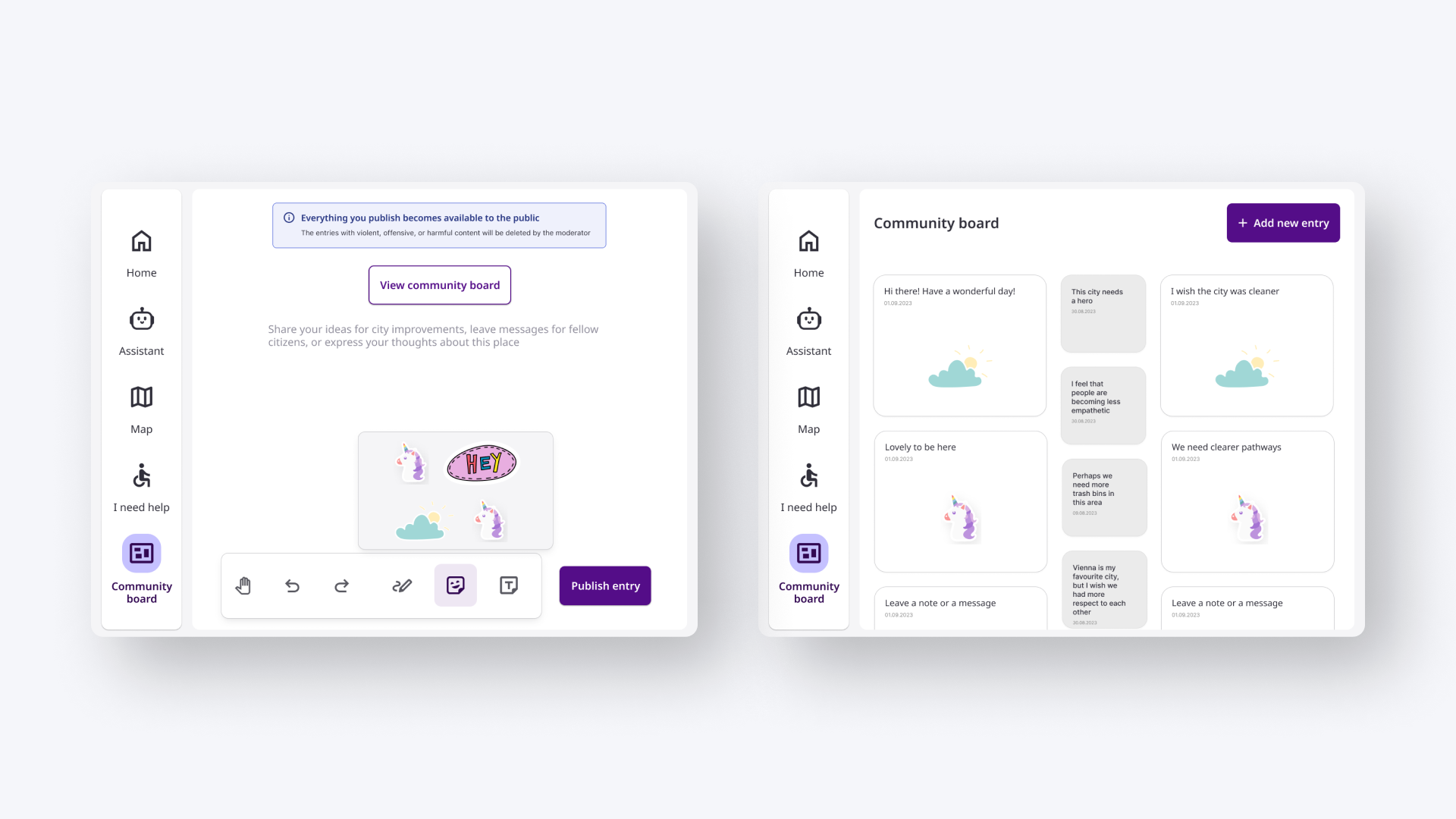
Functionality 4: COMMUNITY BOARD
As a user, Amelia wants to create and share public messages on a community board, so that she can share her ideas on urban planning and show support to other citizens.
Key design decisions
- Add disclaimers before publishing to prevent users from publishing violent and disrepectful content
- Add confirmation message pop-up to remind users about the use of respectful
#5 Research
Co-CREATION: TOOLKIT
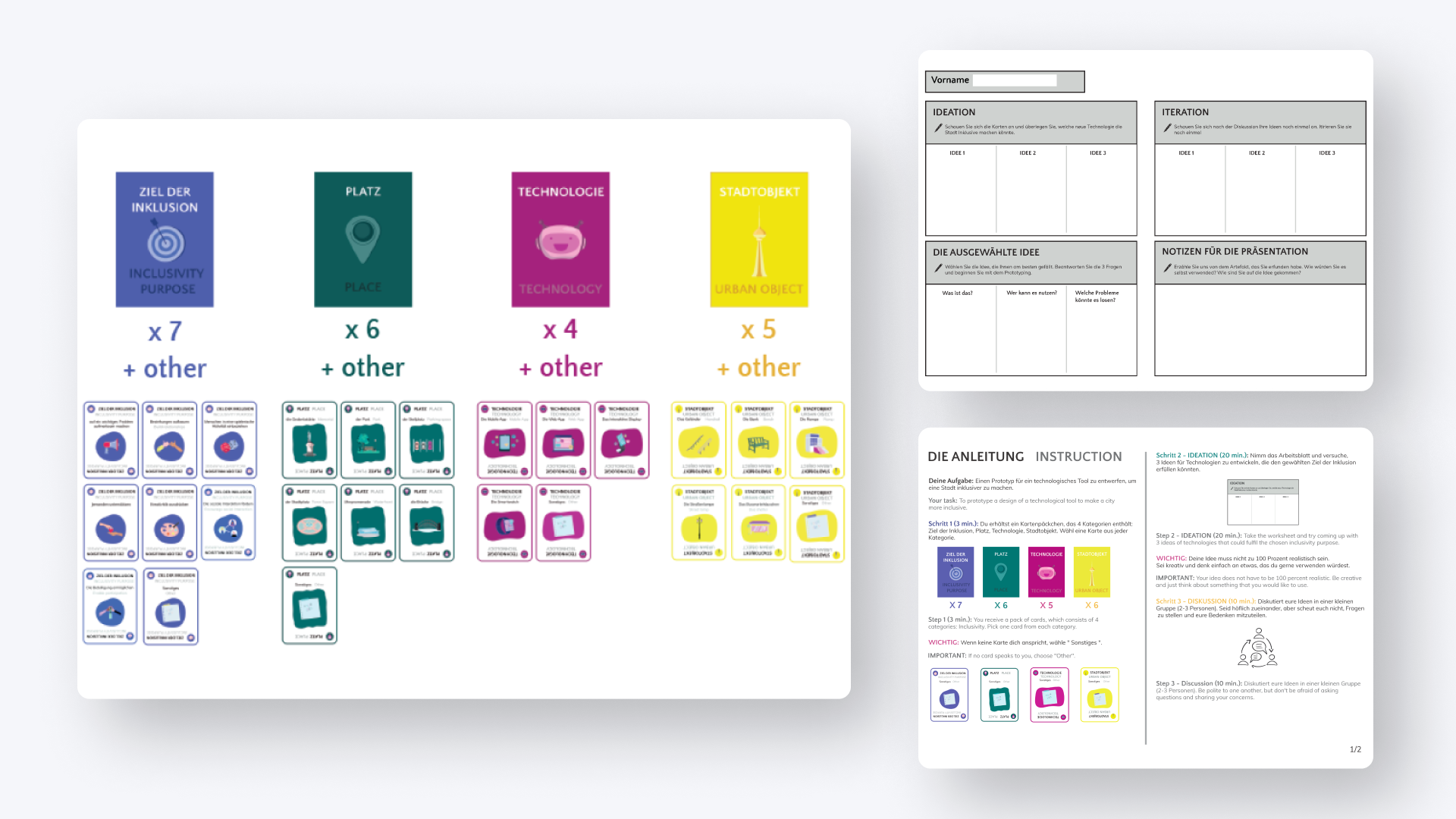
Sanders and Steppers describe co-creation as "any act of collective creativity." This means we involve two or more people in shaping the design vision. Since disability can be a sensitive topic, hands-on activities can provide a space for self-expression and help facilitate discussions among participants. Prior to the session, I've designed the card deck and a worksheet and gathered materials for a toolkit that each participant received. You can download the cards and worksheet from my Dropbox.
The content of Urban Shaper Make Toolkit
- A card deck comprising four sets: Inclusivity Purpose, Place, Technology, and Urban Objects.
- A worksheet to assist in ideation and allow participants to take notes
- Physical DIY materials such as Lego blocks, felts fabrics, paper, and tools to modify them (scissors, tapes, glue).
- An instruction sheet detailing the session structure.
Participants
- five wheelchair users
- four identified as women, one as man
- age from 54 to 59
Co-CREATION: RESULTS & INSIGHTS
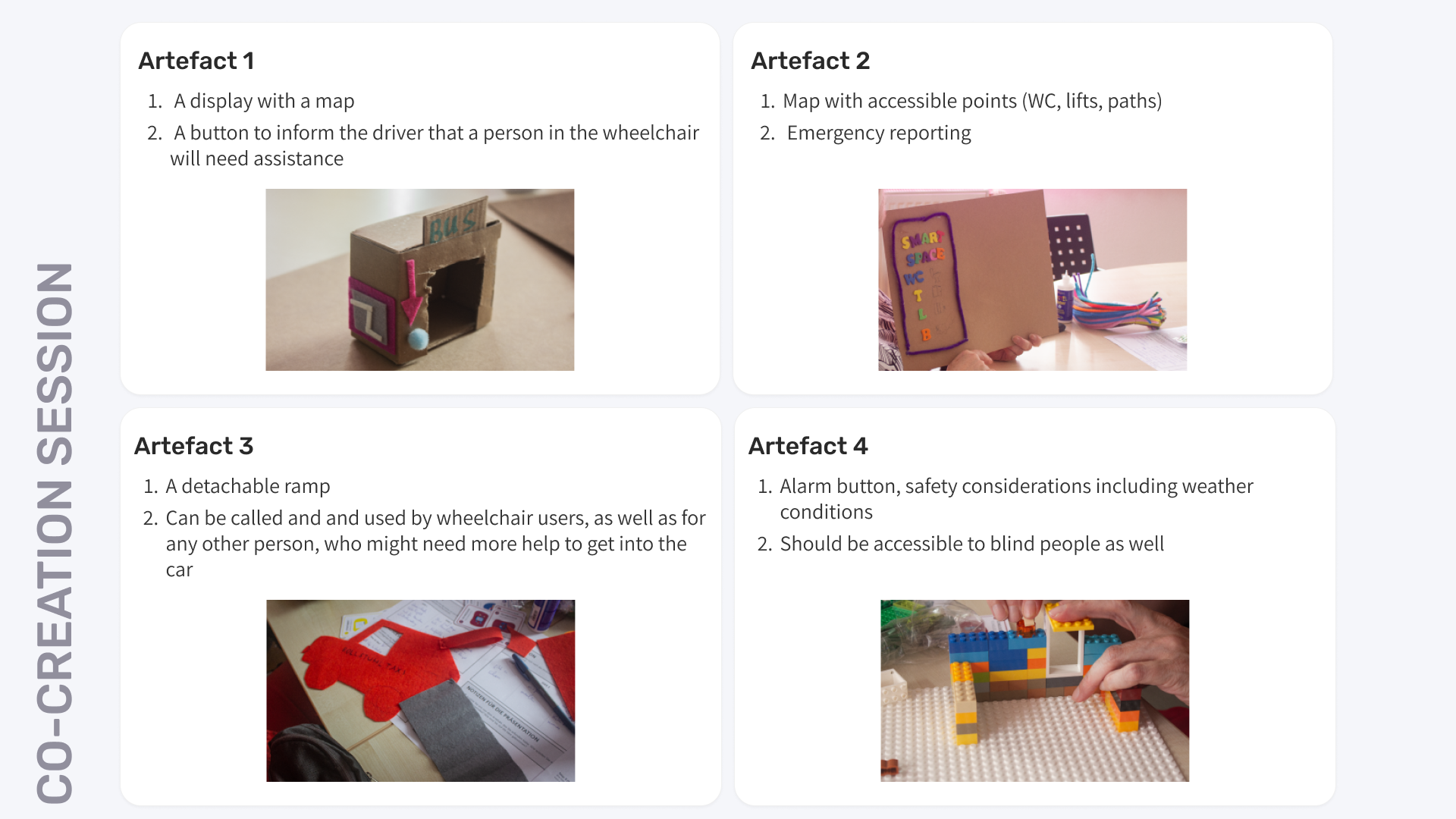
I transcribed the recording of the session and analysed both the text and the artefacts created by the participants through qualitative content analysis. The result was 108 codes divided into 13 categories, which were then sorted into five main themes.
- Making of the Artefacts
All five participants drew inspiration from chosen cards for their artefacts, although one found the cards less helpful for discussion. The abilities of participants were crucial; one required help due to fine motor difficulties, while another used sewing, which requires hand and finger coordination. - Inclusive Urban Mobility
All five participants highlighted that current city accessibility efforts are often lacking. They stressed the need to improve mobility and navigation not just on streets but also within buildings and vehicles like buses and trains, as well as in places like railway stations and bus stops. - Fostering Unity & Empathy
All five participants expressed the need for a platform that brings together people from diverse backgrounds to interact meaningfully and understand that inclusivity is everyone's responsibility. - Neglecting Accessibility
Participants discussed why accessible experiences are often overlooked. They noted that existing norms and standards aren't always implemented seriously, and some issues go unnoticed. Accessibility can also be costly.
One participant suggested that many problems could be avoided if politicians and city planners considered accessibility from the start of projects. - Personal Autonomy & Assistance
Participants highlighted the need for training tailored to their environment and saw potential in technology to make tasks easier. For instance, being able to automatically request help while using public transportation.
One participant mentioned that asking for help can be uncomfortable and stressful, so it's important to ensure places they visit are accessible enough for them to get around on their own
EXPERT INTERVIEWS: RESULTS & INSIGHTS
I conducted three qualitative semi-structured interviews with three different experts and analysed it using the affinity diagramming method.
- Expert 1 (woman, HCI researcher with a background in architecture, specialist in inclusive design and research)
Covered the themes of design of inclusive built envionment, challenges and issues frrom designer's perspective - Expert 2 (man, activist, founder of the Office for the Rights of Persons with Disabilities, wheelchair user)
Covered the themes of activism and participation of people with disabilities in the urban planning, social barriers to inclusive design - Expert 3 (woman, architect specialized in inclusive design, activist, NGO founder)
Covered the themes of design of inclusive built environment, challenges and issues from designer's perspective, social barriers to inclusive design
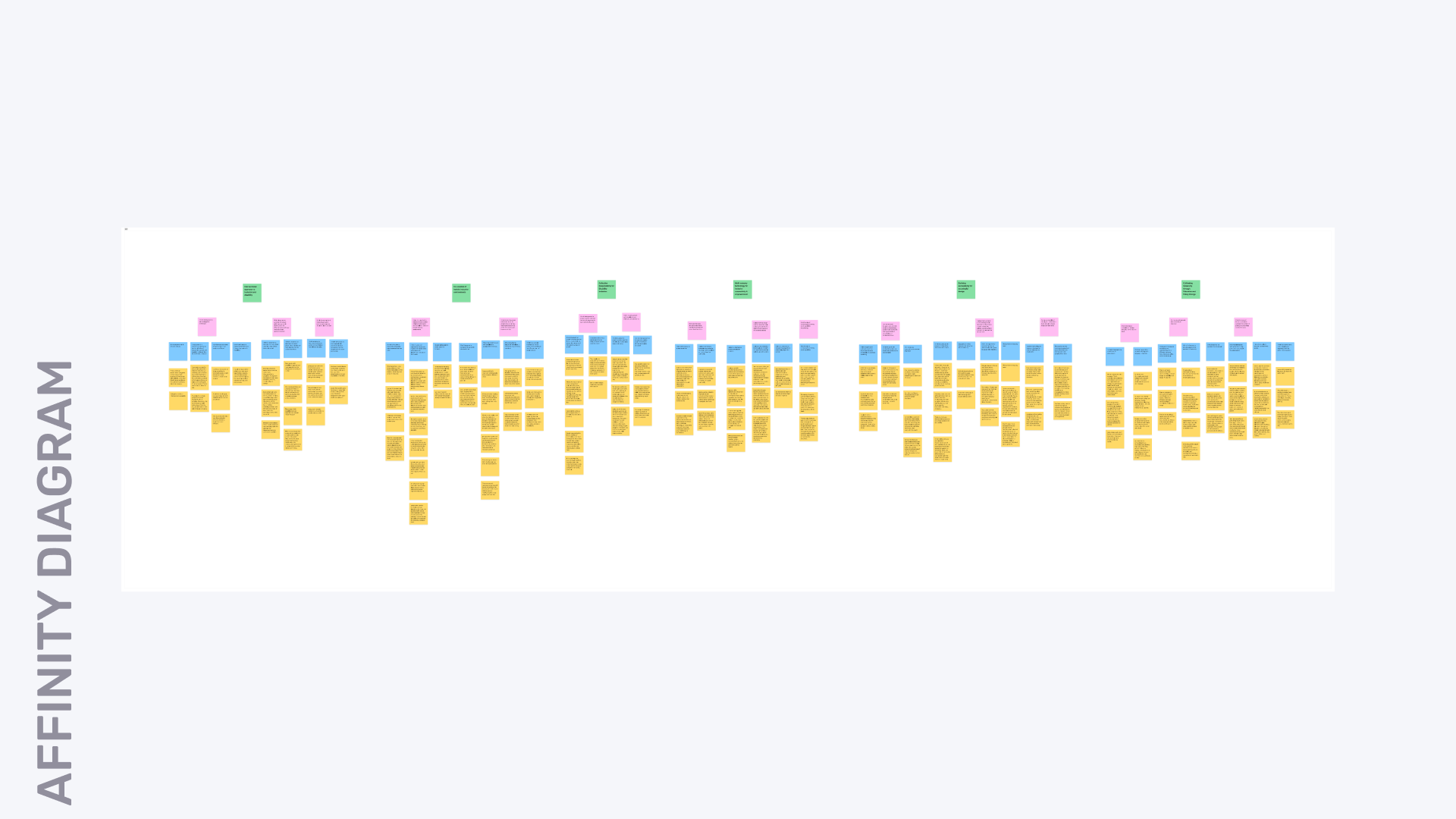
I extracted six main themes from the expert interviews.
- The Intersectional Approach to Inclusivity
This theme emphasizes recognizing the diverse experiences and needs within the disability community and those interacting with them. Designs should allow for low-effort movements and simple layouts, aiming for equity rather than equality. It also highlights the importance of having a diverse design team and valuing their contributions. - Co-creation of Holistic Inclusive Environments
Involving diverse stakeholders, including able-bodied and disabled individuals, is crucial for designing accessible, inviting spaces and fostering connections. To promote accessibility and inclusion, people need to interact outside their social circles. Design should emphasize community-building features and experience sharing, beyond just meeting accessibility guidelines. - The Collective Responsibility For Disability Inclusion
This theme emphasizes that everyone should feel accountable for disability inclusion. Since our abilities change over time, disability affects us all. Most importantly, disability should be seen as a human rights issue, not charity. - The Multi-sensory Technology for Inclusive Connectivity & Empowerment
Designers should include visual, auditory, tactile, and haptic elements, considering various contexts. Solutions should be adaptable, allowing for relocation or removal as user needs change. Technology should connect people, not isolate them, and support both virtual and physical interactions. - The Evolving Accessibility for Meaningful Design
Creating inclusive environments requires more than physical accessibility. Design should address real needs, not just aesthetics, aiming for simple, functional, and understandable solutions. Designers should continuously expand their knowledge and improve accessibility standards.
Experts highlighted the issue of tokenism—symbolic inclusion without real impact. While design alone can't solve all inclusion issues, it is the designer's ethical responsibility to consider the bigger picture and create solutions that alleviate some challenges. - Cultivating Inclusivity Through Education & Policy Change
This theme highlights the need for participatory policymaking, education on inclusivity and disability, and respectful, inclusive language. For designers, this means using careful terminology and creating solutions that avoid perpetuating stereotypes.
#6 LoFi Wireframes
#7 Device concept & Sketch
Interested in working together?
Let’s connect!
Contact me to collaborate on a product, discuss design and research issues, or chat about great books